Before You Sign the Solar Contract: The Electrical Audit Your Home Actually Needs First
The residential solar market in the United States has grown dramatically over the past decade, driven by falling equipment costs, federal tax incentives, and aggressive marketing from installation companies eager to capitalize on consumer interest in energy independence. The pitch is compelling: install panels, reduce your utility bill, protect yourself from rate increases, and contribute to a cleaner energy future.
What the pitch frequently omits is a straightforward question: Is your home's electrical system actually ready to support a solar installation?
For a significant number of American homeowners, the answer is no—and discovering that fact after signing a contract, after equipment is ordered, and after a crew arrives to begin work is an expensive and frustrating way to learn it.
The Gap Between Solar Marketing and Electrical Reality
Solar installation companies are, in most cases, specialists in solar equipment. Their expertise lies in panel selection, mounting systems, inverter configuration, and utility interconnection. What they are not always equipped to assess—and what their proposals frequently do not address—is the condition of the existing electrical infrastructure inside your home.
That infrastructure includes your main service panel, your grounding system, the wiring running through your walls and attic, and the interconnection point where the solar system ties into your home's circuits. Each of these components plays a critical role in whether a solar installation performs safely and efficiently. Each of them can also represent a bottleneck or a failure point that no amount of premium panel technology can compensate for.
Homeowners who discover mid-installation that their 100-amp service panel cannot support a solar system without an upgrade, or that their grounding electrode system does not meet current NEC requirements, are suddenly facing additional costs that were never part of the original proposal—costs that can range from $1,500 for a grounding correction to $5,000 or more for a full panel upgrade.
What an Inadequate Panel Means for Solar Performance
The main service panel is the hub through which all electrical energy in your home flows, including the power generated by solar panels. Most solar installations require a dedicated circuit breaker within that panel for the inverter connection. The NEC's 120 percent rule governs how much combined capacity—utility supply plus solar backfeed—a panel can safely handle.
In practical terms, this means that a 200-amp panel with a 200-amp main breaker has a maximum allowable combined backfeed of 240 amps. If your existing panel is a 100-amp service, or if it is already fully populated with breakers, the solar system cannot be connected without modification. Some older panels—particularly Zinsco and Federal Pacific models still present in millions of American homes—cannot be safely upgraded at all and require complete replacement before any solar work can proceed.
A solar installer who does not examine your panel before generating a proposal is not giving you a complete picture of what your installation will actually cost.
Grounding: The Safety Component That Solar Marketing Never Mentions
Proper grounding is not a detail—it is the foundation upon which electrical safety is built. For solar installations specifically, the NEC requires that the solar array, the inverter, and the electrical panel all share a common, properly bonded grounding system. If your home's existing grounding electrode system is incomplete, corroded, improperly bonded, or nonexistent (a condition found in a surprising number of pre-1970s homes), the solar installation cannot be completed to code without first correcting it.
Inadequate grounding in a solar system creates real hazards. Lightning strikes, grid surges, and inverter faults all rely on the grounding system to safely dissipate energy. Without it, that energy has nowhere to go except through your home's wiring, your appliances, and potentially the people inside.
The Wiring Condition Your Installer May Not Have Examined
Solar panels generate DC power that travels from the roof to an inverter, which converts it to the AC power your home uses. That journey involves wiring runs through attic spaces, along exterior walls, and into the panel room. If your home contains aluminum branch circuit wiring, deteriorated insulation from age or pest damage, or undersized conductors that were acceptable under older code editions but do not meet current standards, those conditions will affect both the safety and the performance of the completed solar system.
An attic full of old wiring is also an attic through which solar installers will be routing new conduit and conductors. Any installer working in that space has both a professional and a legal obligation to note what they observe—but their scope of work does not always include reporting conditions outside their immediate installation area.
What a Proper Pre-Installation Electrical Assessment Should Cover
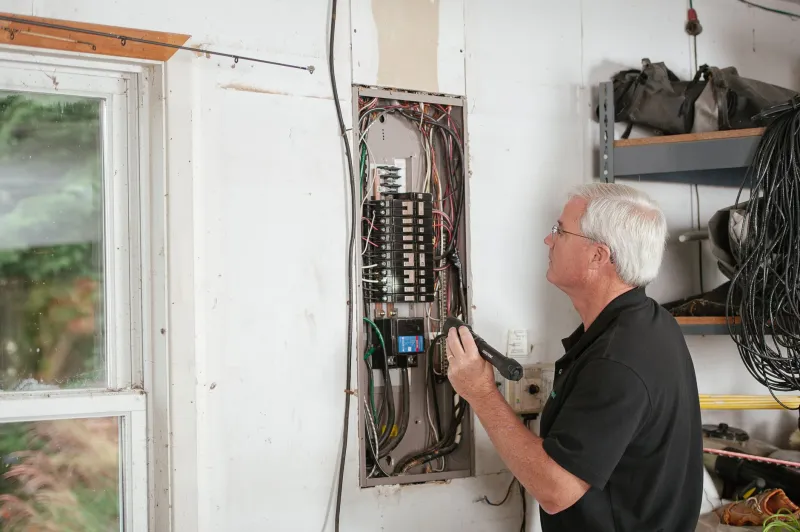
Before executing a solar contract, homeowners should arrange an independent electrical assessment conducted by a licensed electrician who has no financial stake in the solar installation itself. That assessment should include:
- Service panel evaluation: Confirm amperage, available capacity, breaker condition, and compatibility with solar backfeed requirements under the NEC 120 percent rule.
- Grounding system inspection: Verify the presence, condition, and bonding of grounding electrodes, including ground rods, water pipe connections, and concrete-encased electrodes where applicable.
- Wiring condition review: Assess visible wiring in the attic, basement, and panel room for insulation condition, conductor material, and adequacy for the proposed system's requirements.
- Interconnection pathway assessment: Identify the route the solar wiring will travel and flag any existing conditions along that route that require remediation.
- Permit and code compliance review: Confirm that the existing electrical system is in a condition that will pass inspection following the solar installation, since the installation itself triggers a permit process that exposes the entire system to code review.
The Retrofit Cost Nobody Budgets For
Homeowners who skip the pre-installation assessment and proceed directly from solar proposal to signed contract frequently encounter what the industry informally calls "change orders"—additional charges added after work begins when unexpected conditions are discovered. These change orders are legitimate in the sense that the work genuinely needs to be done, but they arrive at the worst possible moment: after the homeowner has committed to the project and after the installer has leverage.
An independent electrical assessment conducted before signing typically costs between $150 and $400. The retrofit work it helps homeowners anticipate and budget for—rather than absorb as a surprise—can easily cost ten to twenty times that amount. The value of knowing what you are actually committing to before you commit is not theoretical. It is financial and practical.
Solar energy is a legitimate and worthwhile investment for millions of American homeowners. But the electrical system that solar panels connect to is not a detail to be evaluated after the contract is signed. It is the first thing that should be examined—and the findings should inform every decision that follows.