What to Look For Before You Close: A Buyer's Electrical Walkthrough That Protects Your Investment
Buying a home in the United States involves a remarkable amount of paperwork, a meaningful amount of negotiation, and—in most transactions—a single general home inspection that is expected to evaluate the entire property in two to three hours. That inspection covers the roof, the foundation, the HVAC system, the plumbing, and the electrical system. It is, by necessity, a broad survey rather than a deep investigation.
For most of the systems in a home, that level of review is adequate. Roof condition, HVAC age, and plumbing function are reasonably assessable in a brief examination. Electrical systems are different. The deficiencies that carry the greatest financial and safety consequences—panel problems, improper wiring practices, outdated equipment combinations—are often invisible to a generalist inspector without specialized knowledge. They are also, in many cases, visible to an informed buyer who knows where to look.
The walkthrough described here takes approximately 15 minutes and requires no tools. It is not a substitute for a professional electrical inspection, which any buyer of a home older than 25 years should strongly consider commissioning separately. It is, however, a systematic method for identifying the red flags that warrant that deeper investigation—and for protecting yourself from the most common and costly electrical surprises in residential real estate.
Start at the Panel: The Document That Tells the Most
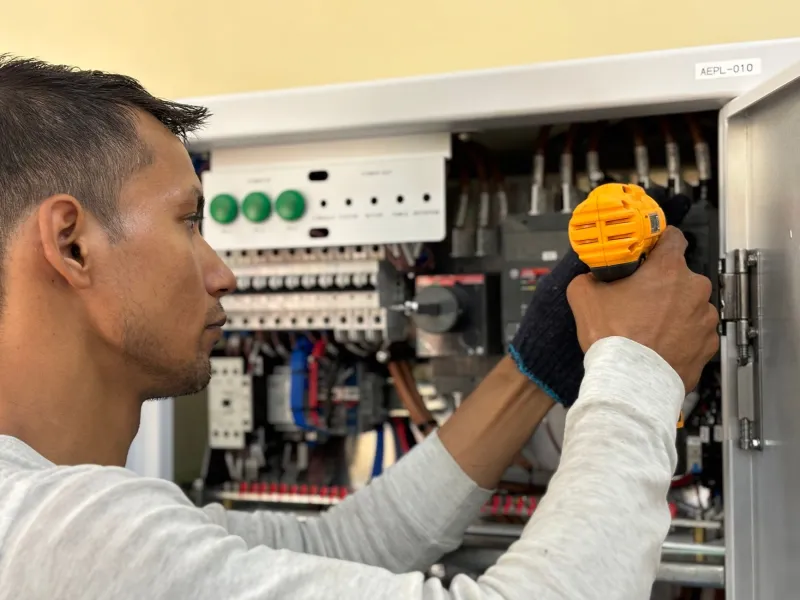
The electrical panel is the first and most important stop on any electrical walkthrough. Locate it—typically in a utility room, garage, basement, or hallway closet—and open the door. You are looking for several things simultaneously.
The brand name on the panel. Certain panel manufacturers have documented histories of defects serious enough to affect insurability and value. Federal Pacific Electric panels, which were installed in millions of American homes between the 1950s and 1980s, have been associated with breakers that fail to trip under overload conditions—a fire hazard that has generated substantial litigation and regulatory attention. Zinsco panels, similarly distributed through the 1970s, have comparable documented failure modes. If either name appears on the panel in the home you are considering, that single finding justifies the cost of a dedicated electrical inspection and a direct conversation with your homeowner's insurance carrier before closing.
Double-tapped breakers. Look at the wiring connections on each breaker. A standard breaker is designed to accept one wire. Two wires connected to a single breaker—a practice known as double-tapping—is a code violation in most jurisdictions and indicates that the panel was expanded beyond its intended capacity at some point. It is not always a catastrophic problem, but it is a reliable indicator of improvised electrical work and warrants professional evaluation.
The service amperage. The main breaker at the top of the panel will be labeled with its amperage rating—typically 60, 100, 150, or 200 amps. A 60-amp service is functionally inadequate for any modern home and will require an upgrade. A 100-amp service is marginal for homes with electric appliances, EV charging, or heat pump systems. Understanding the panel's rated capacity tells you whether the electrical infrastructure is sized for the way you intend to live in the home.
Move to the Outlets: Small Details, Significant Implications
With the panel assessed, work through the home's outlets systematically. You are looking for two specific conditions that are common, consequential, and easy to identify without any equipment.
Backstabbed connections. When an outlet is wired, the installer has two options: connect the wires to the side screws, which creates a secure mechanical connection, or push the wires into spring-loaded holes on the back of the outlet body—a practice called backstabbing. Backstabbed connections are faster to install and were widely used during production home construction. They are also significantly less reliable over time, prone to loosening under thermal cycling, and associated with arcing and outlet failure. You cannot see backstabbed connections without removing the outlet cover, but you can identify their likely presence by testing outlets with a simple plug-in outlet tester, which costs approximately $10 at any hardware store and will indicate open ground or open neutral conditions that frequently accompany degraded backstab connections.
Missing GFCI protection. Ground fault circuit interrupter outlets are required by code in bathrooms, kitchens, garages, basements, and exterior locations. They are identifiable by the TEST and RESET buttons on the outlet face. In a home where these outlets are absent in those locations, the electrical system has not been updated to meet current safety standards. The cost to bring the home into compliance is not prohibitive, but it is a negotiating point and a safety concern that deserves acknowledgment.
Check the Visible Wiring: What Open Spaces Reveal
In homes with unfinished basements, garages, or utility rooms, portions of the electrical wiring are visible. These exposed runs provide a window into the quality and age of the wiring throughout the home.
Aluminum branch circuit wiring. Between approximately 1965 and 1973, aluminum wiring was used extensively in residential construction as a cost-effective alternative to copper. Aluminum wiring is not inherently dangerous, but it requires specific outlet and switch devices rated for aluminum connections, and it expands and contracts at a different rate than copper—creating connection points that loosen over time and can arc. Homes with aluminum branch circuit wiring require either full replacement or the installation of approved copper pigtail connections at every device. If you see silver-colored wiring (copper is orange-brown) in exposed areas, flag it for professional assessment.
Improper junction box coverage. Every junction box—the metal or plastic enclosure where wires are connected—must have a cover plate installed. Uncovered junction boxes are a code violation and a safety hazard. Their presence in visible areas suggests that the electrical work in less visible areas may have been performed with similar disregard for code compliance.
Wiring modifications that appear informal. Extension cords used as permanent wiring, wires running through walls without conduit in areas where conduit is required, or spliced wires outside of junction boxes are all indicators of unpermitted or amateur electrical work. Each of these conditions warrants professional evaluation and disclosure review.
The Smoke Detector Check and What It Tells You
The presence and placement of smoke detectors is not strictly an electrical issue, but it is a reliable proxy for how seriously the home's previous owners treated code compliance. Current residential requirements mandate smoke detectors in every bedroom, outside each sleeping area, and on every level of the home. Homes that lack this coverage—particularly in older construction where detectors were never added—often have parallel gaps in other areas of electrical compliance.
Note the detector type as well. Combination smoke and carbon monoxide detectors are now required in most states for homes with attached garages or gas appliances. Their absence is a disclosure item and, in some jurisdictions, a condition that must be remedied before closing.
Turning Observations Into Leverage
The purpose of this walkthrough is not to alarm you or to manufacture reasons to walk away from a property. Most electrical deficiencies identified in the course of a home purchase are correctable. The purpose is to ensure that you understand what you are buying, that you have the information necessary to make an informed decision about the price you are willing to pay, and that the remediation costs for any identified issues are factored into your offer rather than discovered after closing.
If your walkthrough surfaces any of the conditions described here, the appropriate response is to request a dedicated electrical inspection by a licensed electrician—separate from and in addition to the general home inspection. That inspection will provide a complete scope of work and a defensible cost estimate that you can use in negotiation.
The electrical system is not the most visible feature of any home. It is, however, among the most consequential. Fifteen minutes of informed observation before you close is a straightforward investment in knowing exactly what you are inheriting.