Voltage Without Warning: The Quiet Threat of Power Surges and How to Shield Your Home From Them
There is a particular kind of electrical damage that arrives without any drama. No tripped breaker, no burning smell, no obvious moment of failure. Instead, a refrigerator compressor that should last fifteen years gives out in eight. A smart thermostat starts behaving erratically. A television that worked perfectly on Monday simply will not power on by Thursday. In many of these cases, the culprit is not age or manufacturer defect—it is voltage.
Power surges are brief, intense spikes in electrical voltage that travel through your home's wiring and into every device connected to it. They last milliseconds. They are largely invisible. And according to the Insurance Information Institute, they contribute to billions of dollars in property damage across the United States every year. Understanding where they originate—and how to stop them—is one of the most practical investments a homeowner can make.
Where Surges Actually Come From
Most Americans associate power surges exclusively with lightning strikes, and while lightning is certainly one source, it represents only a fraction of the total surge activity reaching the average home.
Utility grid switching is among the most frequent causes. When power companies reroute electricity across their distribution networks—a routine occurrence during peak demand periods or following localized outages—the transition can introduce momentary voltage irregularities that travel directly to residential customers. These events are rarely announced and often imperceptible, yet they register on sensitive electronics.
Large appliances cycling on and off generate internal surges within the home itself. When a central air conditioning compressor, a refrigerator motor, or a clothes dryer heating element activates, it draws a sudden burst of current. That demand fluctuation can momentarily disturb the voltage across other circuits sharing the same panel. Homes with aging wiring or undersized panels are particularly vulnerable to this effect.
Downed power lines and transformer malfunctions introduce far more severe spikes, often reaching thousands of volts in an instant. These events are less frequent but disproportionately destructive, capable of rendering entire rooms of electronics inoperable in a single incident.
Direct and indirect lightning strikes round out the picture. A direct strike to a utility pole serving your block can send tens of thousands of volts cascading through the grid and into homes connected to it. Even a strike several hundred feet away can induce a damaging surge through electromagnetic effects on nearby wiring.
The Cumulative Cost of Unprotected Circuits
Surge damage is not always catastrophic. In fact, its most insidious characteristic is that it is often incremental. A single moderate surge may not destroy a device outright—it may simply degrade the internal components, shortening the device's operational lifespan by months or years. Homeowners replace appliances and electronics without ever connecting the failure to an electrical event that occurred long before.
Consider the inventory of a typical American home: smart TVs, gaming consoles, desktop and laptop computers, wireless routers, smart home hubs, HVAC control systems, refrigerators with digital displays, dishwashers with electronic control boards, washer and dryer units with programmable cycles, and medical devices such as CPAP machines. The combined replacement value of these items frequently exceeds $15,000 to $20,000. None of that investment is protected by a standard circuit breaker, which is designed to respond to sustained overcurrent—not to instantaneous voltage spikes.
Two Tiers of Surge Protection: Understanding Your Options
Effective surge protection operates on two levels, and a comprehensive strategy typically employs both.
Whole-Home Surge Suppressors
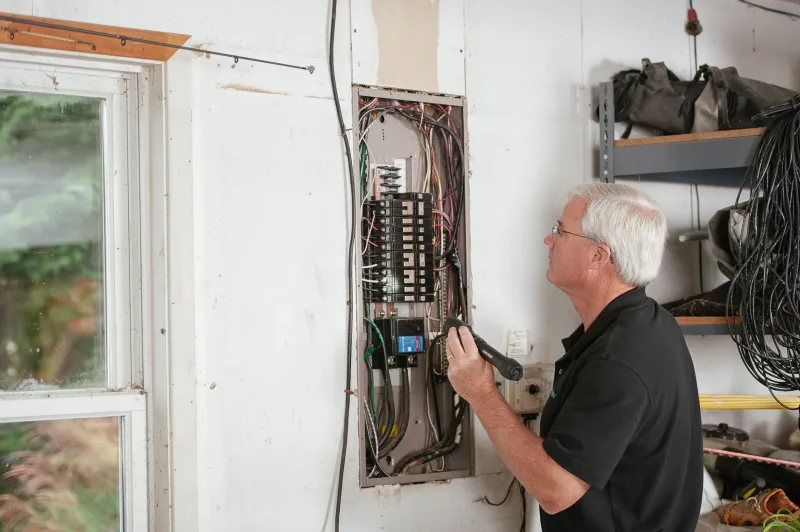
Installed directly at the main electrical panel or immediately downstream from it, a whole-home surge suppressor intercepts voltage spikes before they can travel into the home's branch circuits. These devices are hardwired by a licensed electrician and provide the first and most critical layer of defense.
Whole-home suppressors are rated by their clamping voltage—the threshold at which they begin diverting excess energy—and by their joule capacity, which indicates how much surge energy they can absorb before becoming ineffective. Quality units designed for residential use typically carry ratings between 40,000 and 80,000 amperes of surge current capacity. They are particularly effective against external surges originating from the utility grid or nearby lightning activity.
Installation costs in the United States generally range from $250 to $600 for the device and professional labor combined, depending on panel accessibility and local labor rates. This is a one-time investment that protects every circuit in the home simultaneously.
Point-of-Use Surge Protectors
Commonly sold as power strips with surge protection built in, point-of-use devices provide a second layer of defense at the outlet level. They are most valuable for protecting individual high-value electronics—home theater systems, computer workstations, gaming setups, and home office equipment—from both external surges that may have partially passed through the whole-home suppressor and internal surges generated by other appliances on the same circuit.
Not all surge-protecting power strips are created equal. When evaluating options, look for:
- UL 1449 certification, which confirms the device has been independently tested to meet minimum surge suppression standards
- Joule ratings above 1,000, with higher numbers offering greater cumulative absorption capacity
- Indicator lights that signal when the suppression components have been exhausted and the unit is no longer providing protection
- Connected equipment warranties, which some manufacturers offer as an indication of product confidence
Avoid selecting surge protectors based on price alone. A $12 strip from a discount retailer may carry a surge protection label while offering negligible actual protection.
Building the Right Protection Strategy for Your Home
The appropriate level of surge protection depends on several factors specific to your household.
Geographic location matters considerably. Homes in Florida, Texas, and other states with high annual lightning strike rates face elevated risk from external surges and benefit most from robust whole-home suppression. The National Lightning Safety Council publishes regional strike density data that can help homeowners assess their exposure.
Age and condition of the electrical panel also plays a role. Older panels—particularly those manufactured before modern surge suppression was standard practice—may benefit from upgraded equipment installed alongside a whole-home suppressor.
The density of smart home and electronic devices in the home determines how much point-of-use protection is warranted. A household running a comprehensive smart home ecosystem, a home office, and a home theater faces substantially greater potential loss than one with minimal electronics.
For most American homeowners, the recommended approach is straightforward: begin with a professionally installed whole-home surge suppressor at the panel, then add quality point-of-use protectors at the locations where the most valuable or sensitive equipment is concentrated. This layered approach addresses both the large-scale external events and the smaller internal fluctuations that occur daily.
A Final Word on Professional Installation
Whole-home surge suppressors must be installed by a qualified electrician. Work inside an electrical panel involves live components that carry lethal voltage, and improper installation can void the device's warranty, create fire hazards, or fail to provide the protection the homeowner believes they have purchased. This is not a project suited to a weekend DIY effort, regardless of the homeowner's general comfort with home improvement tasks.
At SK Electricals, we assess each home's specific panel configuration, service capacity, and risk profile before recommending or installing surge protection equipment. The goal is not to sell the most expensive solution—it is to match the right level of protection to the actual exposure your home faces.
The surges are already happening. The question is whether your home is ready for them.