The Extension Cord Is Not a Circuit: Nine Rules Before Temporary Power Becomes Permanent
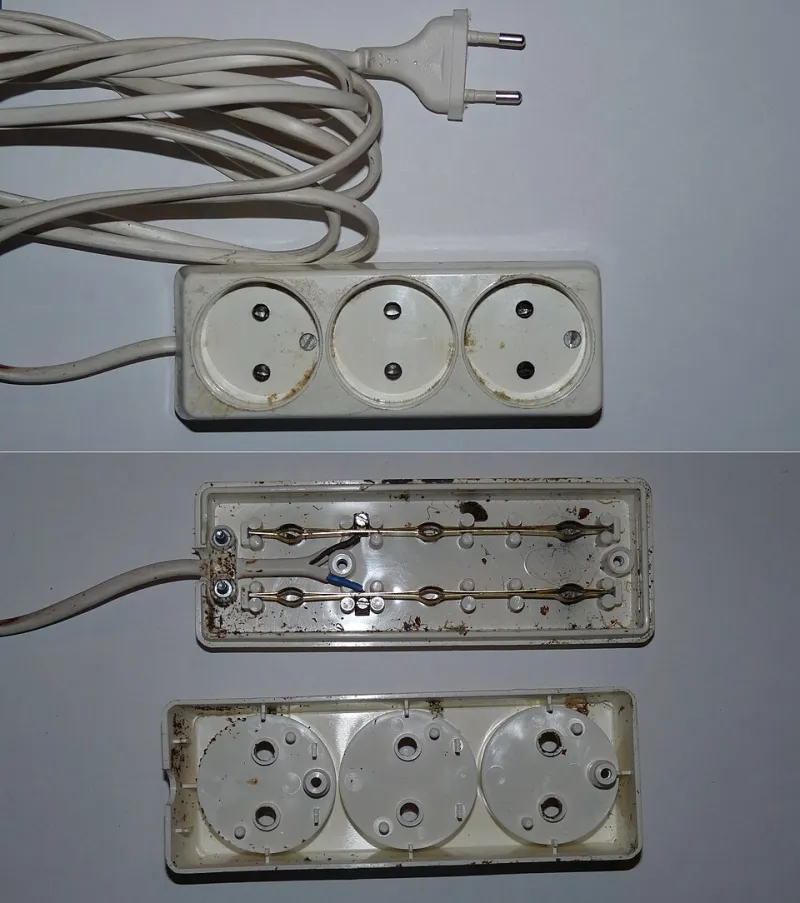
Photo: Dmitry G, CC BY-SA 3.0, via Wikimedia Commons
Nobody holds a meeting and decides to rewire the garage with an extension cord. It simply accumulates. A cord goes out for a project in October. In November it is still there, because the shop light is plugged into it. By spring the freezer is on it too, and the cord has been stapled to a joist, run under a mat, and joined to a second cord with a triple tap. Nothing was decided. Everything was installed.
The electrical code anticipated this. Flexible cords are not permitted as a substitute for fixed wiring, and the list of prohibited uses is specific: through doorways and windows, through holes in walls and ceilings, under floor coverings, attached to building surfaces, and concealed behind panels. The code did not prohibit these uses because it dislikes cords. It prohibited them because each one has produced fires.
The following rules are not a compromise between convenience and safety. They are the minimum.
Rule 1: Audit Whether the Cord Is Still Temporary
Thirty days is a generous definition of temporary. If a cord has been plugged in continuously for a month, it has become branch-circuit wiring without the conduit, the box, or the inspection. Walk the house once a year and count how many cords are load-bearing.
Rule 2: Never Let a Cord Do a Receptacle's Job
A receptacle is anchored, enclosed, and connected to a conductor sized for the circuit. A cord is none of those things. When a room lacks outlets, the answer is outlets, not an adapter that converts one wall position into six.
Rule 3: Stop Running Cords Through Doorways and Under Rugs
A door closes on a cord hundreds of times a year. Each closure compresses the insulation, and compressed insulation eventually cracks. Under a rug, the damage is invisible and the heat cannot escape. Both are textbook ignition scenarios, and both persist for years because nothing visible has gone wrong yet.
Rule 4: Match the Cord to the Load, Not the Plug
The plug fits, so it must be fine, is the most expensive sentence in home electricity. Sixteen-gauge cord is for lamps and small electronics. Fourteen-gauge handles a 15-amp circuit at modest length. Twelve-gauge is the minimum for serious tools, and longer runs require upsizing because voltage drop is real. A space heater, a window air conditioner, or a welder on a household cord is an overload with a schedule.
Rule 5: One Cord, One Strip, One Wall
Daisy-chaining cords and power strips multiplies the load on the first connection while dividing the protection. The breaker at the panel sees the combined draw as a single modest load, and the weakest plug in the chain absorbs the heat. Never plug a power strip into another power strip, and never plug a strip into a cord that is already carrying a load.
Rule 6: Do Not Staple, Nail, or Hang Cords on Metal
Fasteners crush insulation and concentrate strain at the point of contact. Cords hung over nails and metal hooks abrade against a conductive edge every time they move. If a cord must be routed overhead temporarily, use a proper hanger and keep the cord insulated from the support.
Rule 7: Treat Weather as a Component Rating
A cord rated for outdoor use resists sunlight and moisture. A cord that is not so rated will stiffen, crack, and admit water within a season or two, particularly in the cold. Even an outdoor-rated cord should not lie in standing water or remain connected beneath snow for months.
Rule 8: Read the Heat
A warm plug face is a message. So is a discolored outlet, a faint buzzing at the connection, or the smell of hot plastic in a room with nothing running. These are early indicators of resistance at a connection, and the correct response is to stop using the circuit and find out why. Heat at a plug is not normal, no matter how long it has been that way.
Rule 9: Replace the Cord With a Circuit
This is the rule that resolves the other eight. Nearly every chronic extension cord in an American home marks a place where a receptacle should exist. A licensed electrician can add a dedicated circuit for a garage freezer, a workshop bench, or a home office for far less than the cost of the fire such arrangements eventually produce. New circuits are permitted work, they can be ground-fault or arc-fault protected as the location requires, and they come with a documented inspection.
What a Permanent Fix Looks Like
A proper installation is unremarkable by design. Receptacles are placed where equipment actually sits, spaced so that no appliance needs an extension to reach one. Garages receive ground-fault protection as required. Habitable rooms receive arc-fault protection. Workshop circuits are sized for the tools, not for the cord that currently feeds them. The cords go back in the cabinet, where they belong, and they come out only when the work is genuinely temporary.
The extension cord is a useful product with a narrow purpose. It is not a circuit, it is not a receptacle, and it is not a substitute for either one. Every home has a cord that has been in the same outlet too long. This is the week to find it.